|
|
By Pat Lefemine
Founder, Bowsite.com
|
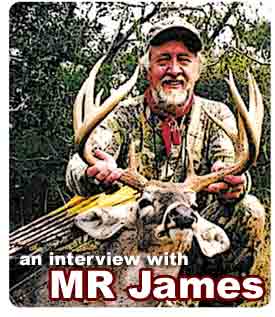
A candid interview with the founder
of Bowhunter Magazine
What got you interested in bowhunting?
I'd always messed around with bows and arrows, making my own and shooting
them as a kid in rural southern Illinois, finally saving up money from
my chores to buy my first "real bow" when I was 11 or 12. I
ruined that store-bought longbow by accidentally sticking its upper limb
tip in the spokes of my bike as I rode to a friend's house. Talk about
being heartbroken! In high school I shot with a friend at a local archery
range and we stalked woodchucks together around our hometown. By the late
'50s I'd started going to weekend National Field Archery Association (NFAA)
tournaments and dabbling in bowhunting small game like squirrels and rabbits
and varmints (there were no deer in Wabash County in those days). I'd
grown up hunting with a .22 or 12 gauge shotgun and found it getting too
easy. Filling a bag limit of bushytails, cottontails, quail, doves, or
waterfowl became routine. One squirrel season I took 25 squirrels with
25 shots just to prove I could do it by taking my time and taking only
good shots. I started seeking more of a challenge and eventually turned
to the bow and arrow for my hunting excitement. During the early '60s
I got serious about bowhunting and went along with my high school buddy
to a deer camp in Pope County, Illinois. I was in college in Indiana at
the time and recall cutting Friday classes to head out bowhunting for
the weekend. The first full season I bowhunted deer (1962) I somehow managed
to stalk within 20 yards of several good bucks -- and yet I never got
a shot. With a firearm it would have been a snap. I was hooked. I'd finally
found a true hunting challenge.
Tell us about the first animal you shot with a bow?
The first animal I shot with a bow was a fox squirrel. As I've already
suggested, I used to be an avid squirrel hunter, and I mostly used a scope-sighted
.22, but 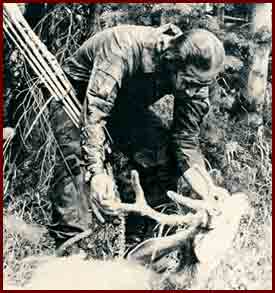 taking
a daily limit of 5 bushytails was not all that tough. Hunting squirrels
with my bow and arrows was much more challenging. I loved it! The first
big game animal I killed was a whitetail buck arrowed in 1963 in Warrick
County, Indiana. It was the last November evening of the statewide archery
season. I jumped a small herd of deer not far from where I'd parked my
car. Trailing after the whitetails in hopes of seeing them again, I bumped
into a rutting buck that was acting goofy as he trailed a hot doe. I was
able to sneak up within 20 yards and shoot him as he grunted and herded
that doe though a briar thicket along a dry creekbed. I was shooting a
48-lb. Colt Huntsman recurve, cedar shafts, and Bear Razorheads. That
old whitetail wore a huge 6-point rack that made the Pope and Young record
book (the P&Y minimum was 115 back then and my deer's rack scored
118 3/8 with basal circumferences of nearly 7 inches). He was a great
trophy for a novice bowhunter and the first 6-pointer to ever make the
bowhunting record book. In retrospect, I realize that very little hunting
skill was involved. Lady Luck sure smiled on me that day. But from then
on I was a committed deer hunter. taking
a daily limit of 5 bushytails was not all that tough. Hunting squirrels
with my bow and arrows was much more challenging. I loved it! The first
big game animal I killed was a whitetail buck arrowed in 1963 in Warrick
County, Indiana. It was the last November evening of the statewide archery
season. I jumped a small herd of deer not far from where I'd parked my
car. Trailing after the whitetails in hopes of seeing them again, I bumped
into a rutting buck that was acting goofy as he trailed a hot doe. I was
able to sneak up within 20 yards and shoot him as he grunted and herded
that doe though a briar thicket along a dry creekbed. I was shooting a
48-lb. Colt Huntsman recurve, cedar shafts, and Bear Razorheads. That
old whitetail wore a huge 6-point rack that made the Pope and Young record
book (the P&Y minimum was 115 back then and my deer's rack scored
118 3/8 with basal circumferences of nearly 7 inches). He was a great
trophy for a novice bowhunter and the first 6-pointer to ever make the
bowhunting record book. In retrospect, I realize that very little hunting
skill was involved. Lady Luck sure smiled on me that day. But from then
on I was a committed deer hunter.
What made you decide to start a bowhunting magazine?
I wrote a piece about that buck called "Beginner's Luck." It was
published in ARCHERY, the NFAA's official monthly publication, in 1965.
That started a friendship with Roy Hoff, the magazine's founder and a
future member of the Archery Hall of Fame. Roy encouraged me to send him
more of my hunting stories, and I did. I'd sold my first stories to national
magazines when I was 19 and worked part-time for daily newspapers while
going to college. My early writings were mostly pulp fiction, Westerns
and murder mysteries, but as I started going on more and more hunting
trips it was natural to write about my hunts. The money I earned from
selling those stories helped me buy more archery tackle and go on still
more hunts. Anyway, from the mid- to late-1960s I wrote numerous articles
for ARCHERY, ARCHERY WORLD, and BOW & ARROW, as well as other outdoor
magazines like FUR-FISH-GAME. I couldn't wait for each new magazine to
arrive in my mailbox, but in those days the three national archery magazines
devoted only part of their content to bowhunting. Since I didn't care
who won which tourney or which new bow was being tested, I found about
half of each issue of little or no interest. I wanted bowhunting stories
-- and so did most of the guys I hung out with. Archery was okay, but
bowhunting was great. It seemed a shame to me that there wasn't a national
magazine devoted exclusively to bowhunting big and small game.
In 1970, while I was working as Communications Manager for The Magnavox
Company in Fort Wayne, Indiana, I befriended three other Magnavox employees
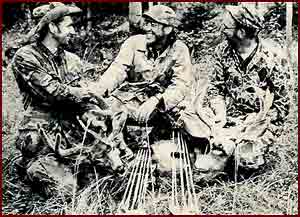 -- Don
Clark, Bob Schisler, and Steve Doucette. We had started a local archery
club at the Izaak Walton Club grounds north of town and while working
on the range or shooting together we agreed it sure would be nice if there
was an all-bowhunting magazine for guys like us. Not knowing any better,
we decided to start one. I already was a published writer and professional
editor. Don and Bob were engineers, but they volunteered to sell ads and
handle subscriptions. Steve, a graphic artist, said he'd be glad to do
layouts. We soon put together an info packet and started talking to various
archery/bowhunting organizations like the Professional Bowhunters Society,
the Pope and Young Club, the Indiana Bowhunters Association, as well as
with potential advertisers. We received lots of encouragement and incorporated
as Blue-J, Inc., Publishers of BOWHUNTER Magazine, in February of 1971.
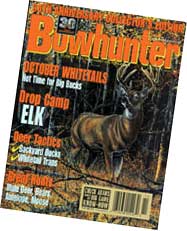
The first issue of BOWHUNTER, subtitled "A New Magazine for the Hunting
Archer," appeared in August of '71. It had 48 pages and cost 60¢
per copy. A 1-year subscription cost $3.00 or you could order 2 years
for $5.50. -- Don
Clark, Bob Schisler, and Steve Doucette. We had started a local archery
club at the Izaak Walton Club grounds north of town and while working
on the range or shooting together we agreed it sure would be nice if there
was an all-bowhunting magazine for guys like us. Not knowing any better,
we decided to start one. I already was a published writer and professional
editor. Don and Bob were engineers, but they volunteered to sell ads and
handle subscriptions. Steve, a graphic artist, said he'd be glad to do
layouts. We soon put together an info packet and started talking to various
archery/bowhunting organizations like the Professional Bowhunters Society,
the Pope and Young Club, the Indiana Bowhunters Association, as well as
with potential advertisers. We received lots of encouragement and incorporated
as Blue-J, Inc., Publishers of BOWHUNTER Magazine, in February of 1971.
The first issue of BOWHUNTER, subtitled "A New Magazine for the Hunting
Archer," appeared in August of '71. It had 48 pages and cost 60¢
per copy. A 1-year subscription cost $3.00 or you could order 2 years
for $5.50.
What were some of the early days at Bowhunter Magazine like?
The early BOWHUNTER days were exciting. The timing for introducing an
all-bowhunting magazine was perfect. An ugly looking contraption called
the
"compound bow" was just bursting on the archery/bowhunting
scene. Also, interest in hunting with bows and arrows was growing, thanks
to Fred Bear, Howard Hill, Bob Swinehart, and other bowhunters who shared
their adventures with an eager, admiring audience of magazine readers
and television viewers. We printed 15,000 copies of that initial issue
and BOWHUNTER was well received from the outset. Our newsstand sales soared
and subscription orders poured in. Don, Bob, Steve, and I would work at
Magnavox all day and spend off hours putting together the next issue of
BOWHUNTER. I can remember meeting magazine deadlines by staying up until
3 or 4 a.m., taking a shower, catching a nap, and going back to my Magnavox
office. It's a good thing we were young back then (in our 30s) because
60- to 70-hour work weeks were the norm. It's a cliché to say it,
but BOWHUNTER was truly a labor of love for all of us. As each issue was
set to be mailed, we'd gather with our wives and kids (who helped us a
lot) and have a "magazine stuffing party" which amounted to
typing address labels and putting thousands of magazines into envelopes.
We soon outgrew such do-it-ourselves mailing methods, but as I said, the
early days were fun. We took considerable pride in having created a magazine
that was so widely accepted.
Fred Wallace, an Ohio-based salesman, joined us in 1973, and we made Fred
a partner a few years later after his ad sales efforts paid off big time.
Each year BOWHUNTER grew in size and numbers of readers. But we kept plowing
profits back into the magazine, none of us drawing any salary for the
first 5 years we were in business. By that time the magazine was on great
financial footing, and in the coming years we "retired" from
Magnavox to become full-time BOWHUNTER employees (all of us except Bob
who worked at Magnavox for over 30 years before retiring). Interestingly,
at the beginning we'd been told by publishing "experts" that
it would take $2 to $3 million to create and publish special interest
magazine. Unfortunately, we didn't have that much in our checking accounts.
But we were stubborn and so we decided to prove the experts wrong. And
we did! Believe it or not, we didn't ever have to borrow any money (except
for a couple of thousand dollars necessary to pay one postage bill), yet
we paid our invoices on time and still had cash left over to invest in
the growing company. It was a heady, rewarding time for all of us. And
before we knew it , thanks to good people and hard work, our little company
had grown into a multi-million dollar publishing operation. By the end
of 5 years we were printing over 80,000 copies and had a paid circulation
of over 57,000. Our ad sales topped $1 million for the first time within
7 or 8 years. In due time our paid circulation eventually reached 225,000.
You've hunted all over, what would you consider to be your favorite game
animal to bowhunt and why?
My favorite game animal is the whitetail. Always has been. Always will be. They're
found almost everywhere across North America and truly are "Everyman's
Deer." Big bucks are almost a separate species of big game and epitomize
the term "challenging." Also, these deer don't care if you're a millionaire
or jobless and on welfare, they treat everyone equally. You can spend as much
money -- or as little -- as you want and still have a memorable time hunting
them. And bowhunting whitetails can be the most satisfying, rewarding outdoor
undertaking you can ever imagine. Yet at the same time hunting these beautiful
deer can be the most frustrating, disappointing experience there is. I love
it! I love whitetails!
Dick Idol, my pal and a Montana neighbor who is known as one of America's most
serious deer hunters, has said a successful deer hunter can travel all over
the world and hunt all kinds of animals, but in the end he's going to return
to whitetail hunting. I believe Dick's right on target with that comment. I
know it's certainly true in my case.
Tell us about your most memorable bowhunt?
I've had a number of memorable bowhunts, but one that immediately comes
to mind is a caribou hunt in the Northwest Territories back in '93. My
wife Janet, our son Dave, and daughter-in-law Norma had flown north of
Yellowknife ahead of the mid-August hunting season opener for some lake
trout fishing before Dave and I tried to fill our caribou tags. One day
Dave and I both arrowed bulls. As our Indian guide was field dressing
Dave's bull his knife slipped and he stabbed himself in his inner thigh,
severing the femoral artery. We worked together using hand pressure and
a tourniquet to staunch the blood spurting from the deep wound. We also
radioed for help rather than try to carry the guide several miles over
uneven tundra back to our boat. A helicopter from a nearby mining company
and a float plane heard the SOS calls and rushed to help us. The chopper
landed on the tundra within 30 yards and rushed the injured guide, Norma,
and me across the lake to 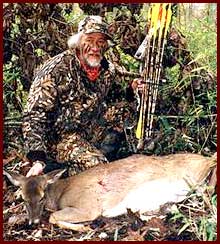 camp
where the float plane was waiting. The plane immediately took off for
Yellowknife where emergency surgery was performed to save the guide's
leg -- and life. Afterwards, his doctor said we'd done all the right things
to keep our guide from bleeding to death. Our guide recovered and was
back in caribou camp the following year. I wrote a story about the hunt
called "A Very Good Day." It was. That near-tragedy was one
hunt none of us will ever forget. It makes you realize just how insignificant
hunting success can be when a man's life is nearly lost in the process.
That experience really put things in perspective for me. camp
where the float plane was waiting. The plane immediately took off for
Yellowknife where emergency surgery was performed to save the guide's
leg -- and life. Afterwards, his doctor said we'd done all the right things
to keep our guide from bleeding to death. Our guide recovered and was
back in caribou camp the following year. I wrote a story about the hunt
called "A Very Good Day." It was. That near-tragedy was one
hunt none of us will ever forget. It makes you realize just how insignificant
hunting success can be when a man's life is nearly lost in the process.
That experience really put things in perspective for me.
How has bowhunting changed for you since those early days?
Bowhunting has changed dramatically from those early years when we learned
to bowhunt mostly through trial and error and we hunted deer from ground
level rather than climbing trees. But the biggest change, without question,
has been in the equipment used. The compound bow forever changed the face
of bowhunting, for better or worse. The replaceable blade broadhead was
another significant bowhunting invention and milestone, as was the widespread
use of tree stands. Also, there's a wealth -- or glut -- of information
available today. We didn't have good books, magazines, videos, seminars,
and websites telling us how and where to hunt. Back when I started bowhunting
it was said it took the "average bow and arrow deer hunter"
6-7 years to take his first animal, and the nationwide success rate was
less than 5%. We only had stickbows in those days, of course, but we still
did pretty well. Even today, with the advent of compound bows and a plethora
of how-to information, the national success rate still averages only a
bit over 15%. That fact underscores bowhunting's inherent difficulty.
Even with all the advancements in technology and information, it's still
not easy to take game with the bow and arrow. That's just how I like it,
too. Most serious bowhunters agree.
In my own case, bowhunting is now more of a business than ever before.
Each year I go on numerous hunts that are made with a particular article
or television show or video in mind. I'm not complaining, mind you, just
stating facts. Some guys think that all I do is hunt (which isn't true,
although I do bowhunt more than most people because writing about hunting
is what I do for a living) and a few people would kill to be able to go
the places I go and hunt the game I hunt. I feel I have the best job on
earth, hands down. But the reality is there are certain business trips
and certain personal hunts which I truly enjoy. I can candidly admit that
there are times when I'd much rather walk out my door and hunt from a
backyard tree stand than get on a plane and travel across the continent
to some distant hunting camp. Believe me when I say it's possible to get
burned out from too much of a good thing. Today I try to be more and more
selective about the hunts I make, but I also understand the need to represent
BOWHUNTER in certain camps. That's business. I much prefer to hunt for
the sheer pleasure and challenge 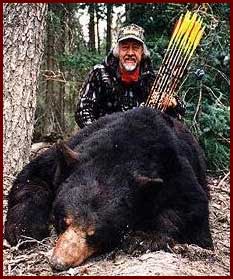 bowhunting
offers. bowhunting
offers.
One quick example of the difference I'm talking about: A couple of years
ago I hunted whitetails in over half a dozen states and traveled thousands
of miles in the process. I took some good bucks but shot the best deer
of the season less than 150 yards from my house on a Montana mountainside.
Guess which deer meant the most to me. I didn't even write about that
hunt. I simply enjoyed the fact I was on my own, without a video camera
or deadline pressure facing me, and I was hunting where and when I wanted,
not because I had a magazine assignment.
With such a long bowhunting career - have you ever been in a situation where
you were in danger or your life was threatened?
I've received occasional death threats from hunter-haters off and on for over
30 years, but I've not taken many of them very seriously. As far as life threatening
situations, I've been in a few hairy places while goat hunting where I knew
that one wrong step could mean falling hundreds of feet. That's made me nervous
a time or two, especially when the rocks were wet or icy. And I've been in bush
planes and boats during bad storms when prospects of getting back on firm ground
in one piece didn't seem too likely at the time. On several other occasions
I've almost been run down by deer, elk, bears -- and that one Alaskan moose
my pal Larry D. Jones arrowed (anyone who has seen the footage on TV or in our
HUNTIN' ACTION video knows how close that bull came to bowling over the camera
and me). But all in all I've not had many close calls. I worry more about driving
to town and back than being done in on some bowhunting adventure.
One might say that you're in the middle with regards to equipment.
You use and promote modern archery tackle, but you're also in favor of limiting
technology and do not support the general use of crossbows during archery season.
How did you arrive at that position and have your views changed through the
years?
My all-time favorite bow is still a Black Widow recurve the Wilson Brothers
made especially for me over 30 years ago. And I have a couple of other
Widows I really like that my buddy Ken Beck made up for me. I just ordered
a new longbow although I still use and like the Bighorn Ram Hunter I've
had for years. At the same time, I just got a new Jennings compound and
I've been shooting Browning and Mathews one-cams for the last several
years. I use some bows because of the business I'm in; I use other bows
because I simply choose to use a certain make and model because I like
'em.
Some of my best friends and hunting buddies are traditionalists; others
use the latest high-tech tackle. Personally I don't care what you use
as long as you use it well. I've met stickbow shooters who shouldn't be
allowed in the woods to hunt because they can't hit the ground 3 shots
out of 5; and I've seen accurate compound-toting speed freaks who don't
have a clue about taking a responsible shot at reasonable ranges, flinging
arrows at distant animals they seem to regard as little more than flesh
and blood 3-D targets. Believe me, there are jerks on both sides of the
equipment issue.
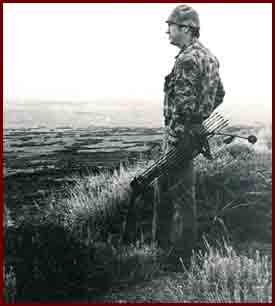
Bowhunting is serious business -- or it should be. I advocate using the
bow, arrow, and broadhead setup that suits you best. I agree with my old
friend and huntin' buddy, G. Fred Asbell, who says that using a longbow
or recurve should never be an excuse for shooting poorly. I'd much rather
see someone shooting a compound accurately than a stickbow poorly. At
the same time, I think it's foolish to continually tinker with a compound,
adding every new gadget that comes along, and trying to coax every possible
fps out of the bow. As my good friend and technical guru Dave Holt says,
"It's better to hit a target with a slow arrow than to miss it with
a fast one." My own compounds mostly shoot around my hunting arrows
230 to 250 fps, which is plenty for the game I hunt at the yardage I shoot.
Most pull about 70 pounds and I mainly shoot Easton 2315s, although I've
used carbons on some hunts with good success. My favorite hunting heads
weigh 125 grains and come in either 3- or 4-blade designs. Being from
the old school of bowhunting, I personally dislike ultra-fast bows, light
arrows, and tiny broadheads.
But compounds and technology are here to stay. Those chest-thumping traditionalists
who put down bows with "training wheels" and the people who
use them, yearning to revert to the days of stickbow-only hunting, are
living in a dream world. Likewise, those gadgeteers who want to reinvent
the gun and use modern archery tackle that takes all the human factor
out of shooting a bow are completely out of touch with the reality of
what bowhunting is all about. The best bowhunters I know would be successful
regardless of what they hunted with. It's their ability and attitude --
not the bow they carry into the woods -- that matters. The my-way-or-no-way
attitude I hear from both traditional and modern bowhunters is, in my
opinion, stupid. Fighting among ourselves delights the antis, creates
hard feelings among groups of hunters, and serves no useful purpose.
Can there be too much technology in bowhunting? Of course. But I've heard
some extremist traditional shooters put down other traditionalists because
they shot a recurve, not a longbow or selfbow. As Gene Wensel, another
old pal might say, "Give me a break!"
Crossbows are not bows and in my opinion have no place in regular archery
seasons. Manufacturers who attempt to get crossbows legalized in statewide
archery seasons are wrong; they're putting potential profit ahead of what's
best for bowhunting. But bowhunters who claim that compounds are "vertical
crossbows" are wrong, too. They're not and won't be until you're
able to cock and shoot them with minimum movement. Crossbows are different.
Period. In field tests I've proved I can shoot a modern crossbow more
accurately at longer yardage than any conventional hunting bow I own.
I've found shooting a crossbow easier, pure and simple. If people want
to use them to hunt deer, fine -- but not during archery seasons. Put
'em in with firearms or in a special primitive weapon season, if necessary.
But keep them out of bow seasons. The people who'd use them are mostly
those who simply want to kill a deer, and killing is not what bow and
arrow hunting is all about. If 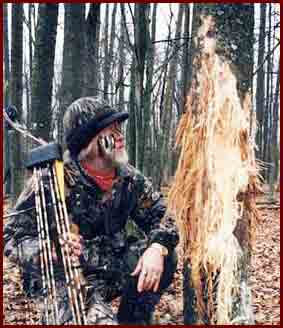 you
have to kill something on a regular basis, use a gun and visit a game
farm. By the way, my sole exception to the general no-crossbow rule would
be a very limited number of severely physically challenged individuals
who otherwise would not be able to hunt. Such truly handicapped hunters
would be welcome in my camp at any time, even if they were using a crossbow. you
have to kill something on a regular basis, use a gun and visit a game
farm. By the way, my sole exception to the general no-crossbow rule would
be a very limited number of severely physically challenged individuals
who otherwise would not be able to hunt. Such truly handicapped hunters
would be welcome in my camp at any time, even if they were using a crossbow.
I base these judgments on over 40 years of personal and professional experience
hunting most big game species across much of North America.
If you could go on only one hunt a year, what would that be?
Only one hunt? I'd probably opt to hunt whitetails not far from home, alone
or with my son Dave or another good buddy. My corner of Montana has some great
deer hunting opportunities -- and some great bucks.
What bowhunts do you have planned for 2002?
I've got a couple of turkey hunts and bear hunts slated this spring.
On one hunt I'll be with ol' pal Jim Dougherty chasin' gobblers. Later
I'll be sharing bear camps with BOWHUNTER Editor Dwight Schuh up in Canada.
In early August I'm off to California to chase blacktails, then I'll head
to the Northwest Territories for a mountain caribou hunt. In mid-September
I'll be in Wyoming for deer. Then it's more whitetail hunting in Nebraska,
Saskatchewan, Illinois, Maryland, and a couple of other states, time permitting.
I have invitations to hunt deer in Iowa, Kansas, Michigan, Alabama, Mississippi,
and Texas. And I'll hunt some here in Montana, too. All I have to do is
find the time.
Where do you see bowhunting in the year in 2025?
I wish I had a crystal ball. It's possible we could be legislated out of existence
by then, but I certainly hope that's not the case. I want to believe bowhunting
will still be alive and well. If it is, it'll likely be more limited than it
is today because there's a finite amount of hunting land available and today's
public woodlands already are becoming increasingly crowded with each successive
season. More and more private land will be posted in the future as landowners
close their property to hunting or lease it to hunting clubs or outfitters willing
to pay top dollar for the privilege to hunt. Bowhunting everywhere will be more
pricey, too. Many guided hunts will be out of the price range of average folks
(that's already happening!), and everything from hunting licenses to tackle
to travel costs will be more and more expensive. Hunting as we know it today
will eventually end, but I hope not during my lifetime. I've been truly blessed
to see and be a part of what I call "The Golden Age" of bowhunting
which spanned the last half of the 20th century and continues to this day.
Frankly, I'm looking forward to 2025. I killed my first mule deer with a bow
in 1965, and I arrowed my best muley buck 30 years later in 1995. Seems Lady
Luck smiles on me every three decades when I'm hunting mule deer, so it's likely
I'll be due to collect a real monster muley in 2025. I'll only be 85 at the
time and tagging another big mule deer buck would be a great birthday present.
|