Bowsite.com
The Nation's Leading Bowhunting Website

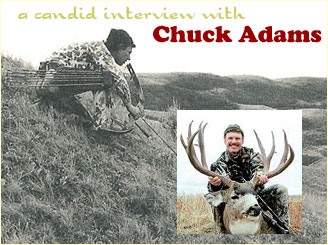
Without question Chuck Adams is the most successful bowhunter of our time. With 5 world records and 122 animals listed in Pope and Young (as of this writing), few will question his achievements. Here on the Bowsite, the 'Adams' threads are legendary - and always "spirited." Some admire him, some despise him, but very few people actually know the man. At the 2004 ATA trade show I asked Chuck if he would allow me to interview him. I told him I was not going to ask any controversial questions - he stopped me there: "I don't mind answering controversial questions - and would be happy to do your interview. "
Some of the questions are informational, some are controversial and others are simply to put some of the speculation to rest. This is a long interview which has been transcribed from our conversation. If you have the time and ability to listen to the audio downloads we highly recommend doing so. At the end of this interview we've included some bonus audio clips where Chuck answers many of the questions you submitted during our interview in July '04. I don't imagine that this interview will end the controversy which follows Chuck Adams in all circles of archery. But hopefully, it will give you just a little more insight into the man behind the grin.
What got you interested in bowhunting?
Chuck Adams: I was born and raised in a hunting family. My grandfather and dad got me started. They were all gun hunters and I found they taught me too well. I was taking my one legal deer a year in my home state of California within a few days after I started hunting. Every year I got to thinking that I anticipated the hunt all year long - yet it was over too fast. So I took up bowhunting in my early teens. I wanted to hunt more and kill less. That’s what got me started. There wasn’t much literature on bowhunting when I started. I read Outdoor Life magazine and read every article about (and by) Fred Bear that I could find. Fred Bear was in his heyday when I was a kid and I just started by trial and error, practicing bowhunting and after three years of bombing out I shot my first deer with a bow and was hooked.
Tell us about the first animal you shot with the bow.
Well I was hunting the Sierra, Nevada Mountains not too far from my hometown of Chico, California. My dad would bring me since I wasn’t old enough to drive on my own. He would drive me up to some pine tree plantations above town where there was a lot of young growth coming up. The black-tailed mule deer hybrids that lived in that country loved those plantations. We'd go up on weekends, primarily when I wasn’t in school, and we would hunt and look for deer. I learned to stalk in that environment. Finally after three years of trying (my third year) I finally got a shot at a little buck. Everything worked out. My dad helped me find it and I was off to the races. Pop was never much of a bowhunter. I talked him into trying it those first couple of years that I bow hunted but he was a firearm enthusiast and I guess you'd call him a "gun nut." He built custom rifles and just could not buy the thought of burning his deer tag every year in California with the bow - because then he couldn't do it with his guns - an ironic twist. You have hunted all over the world, taken a lot of animals. What would you consider to be your favorite game animal to bowhunt and why?
Well it is tough question but I would have to say that elk is my favorite. I just love the elk hunting experience because I like to hunt on foot, I like steep rough country that has a physical challenge and that just happens to be elk country. I don’t believe elk are the most difficult animals in North America but when you combine the fact that they are pretty darn difficult and the fact that they are really noisy during their rutting period (when most of these bow hunt elk are) and combine those two things with the absolutely gorgeous and then very difficult country that’s my number one favorite. But big deer are a close second. A big deer of any variety - I don’t care it’s a black-tailed, mule deer, or white-tailed - It is the most difficult animal in North America in my opinion to kill with a bow. If you have a trophy deer that is four and half years old or older, they know about human hunters, and they are really tough. So it would be elk number one and any kind of big, trophy, deer - number two.
I know this is going to be a tough question for you but if you were to pick one hunt as your most memorable, which one would that be?
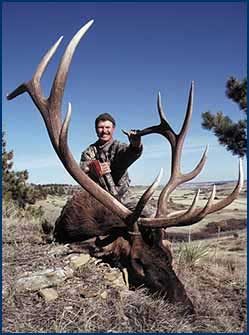
Well that is a tough question. Every hunt for me is memorable for one reason or another. But I think it would be the hunt for my current world record typical Yellowstone elk with Pope & Young. I saw that elk the year before I actually got that elk. I had already shot my elk in Montana and was mule deer hunting. It was four days after I had shot my elk that I saw the huge bull and watched it for couple of hours in a very approachable spot. But I had no tag in my pocket. So I thought about that elk everyday and every night for a year and went back there in the year 2000 - with high hopes and a lot of trepidation that I would never see him again. But I did find him. My guide and I found that elk the first day we looked for him - in the same dark canyon a long way from the road. Like a lot of bull elk, he had come back to the same area to rut even though he wasn’t local. We covered a lot of ground and found him a couple of times before I finally shot him. That was really memorable because of all the thinking I did about that bull the year before I actually got it - and
the fact that he is just an immense animal. I believe he was bigger the year before I got him than he was in 2000. He was a big 7” x 7” in 1999 and he was a 6” x 7” when he was shot. He looked very much the same - I mean there was no question - he was the same elk. I think the drought in 2000 had probably made his antlers just a little bit smaller. But it's still the 14th largest elk ever shot on record in North America with bow or gun and the current world record with Pope and Young for the typical Yellowstone category. It's also the world record for Safari Club International with bow and gun. So it’s an awesome animal and it was just an awesome hunt. If you could only go on one hunt a year what would that be?
If I could only go on one hunt a year I guess it would have to be bowhunting elk somewhere. I don’t know if it would be hunting in my all time favorite state of Montana. It certainly would be now. It would be somewhere hunting big animals. I like to look at big antlers in particular and so it would be somewhere where I thought I could at least lay my eyes on a big bull elk. It’s a very exciting hunt for me. People have written that ego drives your bowhunting career not passion for bowhunting. How do you respond to that criticism?
Well I just laugh at that criticism. Of course, I have heard that. I
would argue that people who say that are driven by ego and jealousy and anybody
who knows me, knows that I absolutely love to hunt and that’s what drives
me. A lot of people (in what I call the "hunting industry" ) hunt
to make money and I have always done the opposite. I work my butt off, most
of the year, to make money so I can go hunt. I just absolutely love to hunt.
I was obsessed since I was old enough to follow my dad around with a little
toy gun - when I was 5 or 6 years old. So anybody who makes that comment
doesn’t know me and has never You’ve gone on some really expensive hunts. Yet in your book you claim that you live modestly, have very few mounts, and have even made references to being broke at various points in your life. How do you afford the hunting you do?
I think it's all about priorities. And when you say "really expensive hunts" I actually don’t spend that much money per year (on average) hunting. Whenever it’s legally possible, I do not hunt with a guide. I like doing self-guided hunts, not just because they are inexpensive but because I think they are the most challenging thing I can do. I have to plan those hunts. I have to do all the scouting. When I do manage to get an animal it’s maybe just a little more rewarding to me because of the friends that I am hunting with, and because I have done all the work. That’s not knocking Outfitters. Some of my best friends are Outfitters and I hunt with guides regularly. Partly because it’s the only legal way you can hunt in places like Montana, as a non-resident. I have a friend who bought a huge and expensive Motor home a few years ago and he was giving me a hard time about going on a Polar bear, or desert sheep hunt - whatever. I just laughed and pointed out the window at the Motor home. I said "that thing cost twice as much as I have ever spent in an entire hunting year - your priorities are just different than mine." I don’t have a Motor home. I have a 7 or 8-year old Toyota pick up and that’s my only wheels in the world. I prefer to spend my money on a desert sheep, or a polar bear, or a brown bear, or something a lot less expensive than that. So I think it’s just a matter of priorities. I don’t believe, for example, that anybody with a normal job and enough vacation time is denied the chance to go after the super slam. If a person with a middle-class income wanted to do that, and had his priorities aimed that way - he could do it. I really don’t think it’s beyond the financial capabilities of anybody. I started with nothing. Sure I hear some occasional detractors say “oh yeah, he was born with a silver spoon in his mouth.” Well how the heck would they know that? I worked my way through college. Every cent I had, and have is money that I earn by working hard. I don’t make any apologies for going on an occasional "expensive" hunt. My number one priority in the world is to enjoy myself hunting. Explain your current equipment setup, are you still shooting fingers? Type of bow, etc.?
I am still a finger shooter. I recommend in my articles, seminars, and on occasional television programs that people shoot a release aid because I think that’s the fastest way to good accurate shooting with a bow. It’s also the fastest way to tune your bow. I have been shooting fingers for almost 40 years. And I am reasonably accurate that way. I am accurate enough with fingers that I don’t feel any need to switch over to a release. One of my philosophies about bowhunting is you choose the simplest setup you can shoot well - and can take animals consistently. The more complex the set up, the more there is to go wrong. Fingers are a lot simpler than a release aid. I know my fingers aren’t going to fall off, I know they are not going to jam up. I know I can shoot faster with my fingers than I could ever shoot with a release aid in crunch situations. You can hook your release up the entire time while sitting in a treestand. But if you walk around for good chunks of the day, it is not comfortable, or practical, to have your release aid hooked-up to the string. And some of the best animals I have taken, I don’t believe, I'd have shot with a release because things happened too quickly. That includes my current world record elk. It includes my current world record Mountain Caribou. Those two animals and several others didn’t give me enough time to take a shot; it was a surprise when they gave me the shot. I am not recommending fingers to anybody else because it’s more difficult and you get better accuracy with the release in general. But for me - fingers are the way to go. For my bow I am shooting a Reflex Caribou Compound Bow. Reflex is a division of Hoyt USA. It’s one of only two compound bows on the market that I consider to be a good finger compound bow - mainly because of the long axle-to-axle length. They are both about 46 inches long, axle-to-axle. They are long enough that a finger shooter can shoot without getting dramatic string pinch around the fingers. If you get too much string pinch, the string is going to hang up in your fingers and you are not going to have a smooth release.
I still shoot aluminum arrows. That surprises some people. I know that carbon is all the rage these days, but I am meticulous about checking arrow straightness, weight, and wall thickness of arrows. I know that aluminum (in the very top grade shafts) is more precisely manufactured than carbon. And I would debate that with anybody because the facts are the facts. Aluminum is guaranteed straighter from the factory and spins better across arrow rollers. Especially for a finger shooter, you have to have straight arrows to get good accuracy with broadheads. So I still shoot aluminum, I shoot XX78 Super Slam Shafts from Easton. I make my own tabs from scratch. I don’t shoot a glove because I think a tab is more accurate. Tabs distribute the pressure on the string more evenly across your fingers and do not groove out over time like a glove does. My tabs are a lot like the tabs many finger shooters shoot but I actually use shop leather and cutout my custom tabs to fit my hand size. My tabs last 4-5 years and I shoot a lot. Just about everything I do, and shoot, is customized in some way or another. Very little of my shooting gear is right off the shelf. The odds of shooting a world record animal are staggering. The odds of shooting 5 are probably beyond comprehension. What do you think sets you apart from other bow hunters?
Chuck Adams: In regard to world record animals? Interviewer: Well just your success. Chuck Adams: Oh okay. I'll address World Record Animal first. I think there are certain world record categories that are beatable and part of the reason I have 5 world record animals is because I have concentrated in some categories where the existing world records were beatable. When I shot my world record coues whitetail deer in Arizona, that record was beatable. That deer was the fist deer I shot with a bow that made Boone and Crockett. And it’s been eclipsed several times since. My Bison (which was world record for couple of years - shot in northern Arizona) was another category where I firmly believed that with hard hunting, research and lot of luck, the existing world record animal could be beaten. And I was right.
I've got this theory that if I'm going to spend my valuable vacation time - and I do regard hunting time as vacation time (I don’t regard it as work time) - I'm going to spend my vacation time hunting big animals. This is because number #1, it’s more difficult than small animals on average and number #2 because big antlers are works of art. I just love big animals and big horns. I scour the record books and talk to lot of booking agents, outfitters, and Fish and Game officials. I try to always go hunting where I (at least) have an off-chance of laying eyes on a big animal. And by doing that consistently over almost 40 years of bowhunting - I have put myself in good spots with the potential for big animals. Places where you know there are those golden three things you need for big animals. Good genetics, good feed, and fairly light hunting pressure. I have put myself in those areas on a regular basis and I think that’s one of the main reasons I've come up with some pretty good animals. I shoot my bow couple of times a week, year round. I love to shoot a bow for shooting sake, and I also like to be accurate when hunting season rolls around. So I think I have got a pretty good handle on the shooting end of the sport. Then when I am out there I hunt hard. I hunt from daylight to dark if it makes any sense to do that. And anybody who knows me will tell you that I am a very persistent guy. I just keep throwing myself back at the challenge until something happens - or the season closes. I would say those things combine to help me out year-to-year. The only other advantage is that I have set my life up so I have more time to hunt. I work probably more hours than anybody I know. I cluster those hours in 8 or 9 months a year and rarely take weekends off. But when I go hunting, I go hunting, and when I set up an elk, bear or any type of hunt I try to make it an open ended hunt where I can spend extra days - if I need to - to find or pursue a big animal. And that makes a huge difference. If I had been on a standard 5 or 7-day hunt, or if I was only allotted so much vacation time, I would not have gotten a big animal. One example is my big Alaskan Brown Bear which I shot in 1989 with Brent Jones. That standard guided hunt was 10 days. The whole season that year on the Alaskan Peninsula was 21 days. And I booked the whole season with Brent. So we had 21 days total. Had I not done that I would not have gotten my Brown bear because I shot my Bear on the 15th day. So that’s one advantage I think I have, and it’s an advantage that didn't just fall in my lap - it’s an advantage that I set up a whole bunch of years ago because I decided bowhunting was number 1 in my life. That has been a structure of my whole life so I can bowhunt in August, September, October, November - when most of the bowhunting seasons occur. Do you ever get buck fever or target panic?
I did have target panic a couple of times in the last 20
years. The worst target panic I had was about 20 years ago. I got to freezing
so badly below the bull’s-eye that I actually had to sight my bow in especially
for that season. I couldn’t get on a bull’s eye and I couldn’t get on the
kill spot on an animal target either. So I deliberately sighted my bow so
I was hitting high. I got through that hunting season without missing a shot
on an animal. But I had bad target panic and the only way I solved it was
after hunting season with a bull’s eye that was huge. I started shooting
at 5 yards then I systematically made the bull’s-eye smaller and increased
the shooting distance over 3 months to retrain myself to aim at the bull’s-eye.
It was painful and it was almost ridiculous because all my sights were on
that big bull’s-eye, but by just systematically retraining myself, I got over
it. I had a little relapse a few years ago, but it didn’t take too much to
work out that time by doing, basically, the same thing. I used to get buck fever when I started bowhunting. Particularly the first 3 years I hunted when I was so excited I couldn’t draw my old recurve bow. I had one buck walk away from me in Northern California. I never shot because I couldn’t get my bow back. And as the years went by, and after getting more experience with animals, I developed the ability to control that excitement. I find that I get very excited before I draw my bow. I could feel my heart pumping and my hands were actually shaking. Other people who have been with me when I was hunting have noticed it more than I have. They point it out to me, and so I watch for it now more than I used to. But absolutely, I get just as pumped as I ever did. When I draw my bow I get really solid and I am sure my heart rate gets up there. But I quit shaking and I settle down and make the shot. After I make the shot - that’s when my knees get weak and I might even have to sit down. But thank goodness that’s when it happens and not during the shot. Explain your practice regimen. How you prepare for your hunts, physical training etc.
I shoot bull’s-eye most of the time, I know a lot of bowhunters don’t. They stress the practice on animal targets as being very important. I bear down and shoot the best during off-season on bull’s-eyes and it trains me to shoot at non bull’s-eye targets. So I never had a problem with picking a spot on an animal and pretending that’s a bull’s-eye. I shoot bull’s-eye most of the time and I actually monitor my shooting. I shoot the old PAA ‘300’ round, year-round. It’s about a 3¼” bull’s-eye that’s a 5 spot and then it goes up to 4, 3, 2 and 1. And I know what I used to shoot score-wise. I could tell you what I shot on indoor tournaments - even 30 years ago. I know how well I shoot year-to-year on that round and it gives me a gauge of how well I am doing compared to how well I did last year, or ten years ago. I routinely shoot in the high 290s on the 300 rounds with my fingers. It’s a 20-yard target round so I will shoot either half round 30 arrows or full round 60 arrows at 20 yards. And that gives me a gauge for what I need to improve - or if I am doing just fine. But mixed with that I shoot at all distances out to 70 yards. I do have a 70-yard pin on my bow. I don’t apologize for that since I don’t shoot animals that far. My experience has always told me that if I practice at longer range the shorter-range shots are almost slam-dunks and I think it’s important to practice at a variety of yardages. I also shoot stumps quite a bit and accelerate that program in the late spring and early summer months. I like to go with friends and shoot long distance with no ranging aids. It’s a great exercise for estimating range by eye. And that’s basically the strategy, which works for me. As far as getting physically prepared for hunting season I do enough physical bowhunting in the summer and fall that I don’t feel like I get too far out of shape. I live in a mountainous area and I do a lot of hiking and cross-country skiing in the winter. I'm always in airports - I mean it seems like every week of my life in the later winter and spring I'm going from one seminar spot to the next. I would skip the moving walkways and always walk as much as I can. I take the stairs, not the elevators, etc. That’s basically all that I do. I am not on any real serious gym regimen. I may have to do that someday but I don't have to do that just yet. You have been highly criticized for writing about shots deemed unethical by the NBEF - and other bowhunting writers. Has your opinion changed about taking long shots?
My opinion really hasn’t changed about taking long shots. I am actually an official mentor for the NBEF - a lot of people don’t know that. I also worked with the late Bill Wadsworth, originator of NBEF and one of the founding fathers. I worked with them to come up with some of the current language. And so when people say that I am counter to the NBEF, I just try to set them straight because I have been a strong supporter of NBEF and I worked with those folks for quite a few years. They asked me a number of years ago to be an official mentor so obviously I am in their court. In a nutshell, I guess my feeling about longer range shooting
is this: Some people earn the right to shoot farther than other people because
they work harder at becoming good shots. If you don’t feel that you need
to shoot beyond 20 or 25 yards and never practice beyond 20-25 yards, that’s
fine. But I know people who are such fanatics about bow tuning that they
could shoot 2” groups at 20 yards. They don’t even need fletching on their
arrows and still have broadheads on the tip. I know people who are so dangerous
at longer ranges with their bows that I'd surely not want them to shoot at
me because I know I'd be dead every time. So I think everybody needs to think
about what his or her own personal shooting capabilities are at a particular
distance and not The late great Fred Bear made no bones about shooting an animal with his recurve bow up to 60 yards or more. Saxton Pope and Art Young collaborated on the fourth biggest grizzly bear in Pope and Young which they killed somewhere around 70 yards with a longbow. It's ironic that today, where the equipment is more accurate than ever before, there are bow hunters who get genuinely upset when they hear about somebody shooting beyond 30 or 35 yards. I don’t quite honestly understand that. When you look at official Pope & Young statistics on animals entered in the record book it's a real eye-opener too. For example many of the top record book mule deer in Pope & Young where shot beyond 40 or 50 yards. Many of the rocky mountain goats, dall sheep, bighorn sheep and stone sheep in the book were shot beyond 40 or 50 yards. Fred Bear shot his former world record stone sheep at 60 yards with his recurve bow and he made no apologizes for that and killed it dead. So I think it really boils down to what an individual person can do. It's a mistake to just zero-in on shooting distance because there are other factors just as important that I don’t hear anybody ever talking about. For example; animal attitude. If a deer is wild and alert, ears cupped back, and if it smells a rat - you don’t want to shoot at that deer even if it's 20 yards away. If there's intervening foliage that might deflect your arrow, you don’t want to shoot the animal even if it’s 10 yards away. If you have clear shot at a very relaxed animal - particularly if it’s a specie that doesn’t jump the string as badly as whitetailed deer (a bighorn sheep which is really calm by nature) why not take the shot if you know you can take it? I got some criticism for shooting my world record elk at 39 yards in the year 2000. Yet when you look at the fact that a big bull elk has a chest cavity 16 inches deep - and a big white-tailed deer has a chest cavity 8 inches deep why would somebody shoot at that 8-inch chest cavity on a white-tailed deer at 20 yards but refrain from shooting at a target twice as big at 40 yards? Mathematically, it’s the same shot because your arrow is going to diverge at the same rate. You should be able to keep all your arrows in a whitetail deer's vital area at 20 yards and also keep your arrows in the elk's vital area at 40 yards. So some of that stuff doesn’t make a lot of sense to me. What is your opinion on traditional equipment and traditional bowhunters?
I started out hunting with traditional gear because that’s all that was available. When I started bowhunting there was no such thing as the compound bow. Today I own over three dozen recurve bows by various older and contemporary custom makers. I own over a dozen long bows and I shoot those bows fairly regularly - just for the fun of it. When I go pheasant hunting with the bow - which I do occasionally - I take a recurve because it’s faster, smoother, and quicker for me to shoot. And because I do shoot fingers I can do it. I really don’t think it matters what somebody shoots for a shooting tool. I think bowhunting is bowhunting and I really think the difference between compounds and non-compounds is overblown by some people. For example; when I shot a recurve indoors on that PAA round (I imagine
back when I was in my teens in early 20s) I shot in the mid 290s on that round
with a recurve. Today, with a compound bow, I shoot in the mid-high 290s.
So I am not shooting more than probably one percent better on that
3.25" bulls-eye at But I do rebel against the notion I hear recurve and longbow-shooters mention (dyed in the wool ones anyways) that recurve and longbow shooting is easier - and it's more fun because it's easier. I feel just the opposite. My hat's off to anybody who is accurate with a longbow or recurve because I know in my heart that it’s a lot more difficult. You've got to practice a lot more than you do with the compound to keep your muscles in shape. You've got to develop that very fine feel for aiming without sights. I think it’s a mistake to just grab a recurve or longbow, go hunting and say this is easier and I am going to have fun. I think you have to be dedicated and I think you have a responsibility (like all bowhunters do) to be good enough with that particular tool to cleanly kill animals. That means practicing more and keeping your shots closer. I get along with traditional archers in general and actually don’t even really differentiate between the groups. The only thing I would say that disturbs me about some traditional archers is, for a small percentage, it's not a sport but a religion. I know this is a controversial statement. I don’t know too many serious compound shooters who haven’t had a non-compound shooter in their face at one time or another in a hunting camp, or at the local archery club. Chiding the compound shooter for shooting "training" wheels on his bow or for making it "too easy" for him and taking unfair advantage over the animals. I just think that's a bunch of bunk. I think bowhunting is bowhunting. It's all difficult. There are far too many factors beside the bow that enter into the equation to make the bow very important. I also think we need to stick together and what I see is that small few, very vocal number of traditional shooters loathing over the compound shooters. That does disturb me, because it divides our ranks and it makes us look kind of silly. I don’t think it accomplishes a darned thing. What are your thoughts on the increased commercialization of bowhunting and the rising cost of hunting - through leasing and higher outfitting costs etc?
Well as I said before, I always hunt on my own if I can legally do it and most of the on-my-own hunting is done on public land. It is distressing to see a lot of formally accessible private land being leased up. But I don’t think, there is any point in kicking about it because that’s just is the way things are going. We can complain about it, and we could say "boy I wish I could get permission on the farm down the road like I did 20 years ago." But if you cant because an outfitter has got it leased, or a sportsmen's groups' got it leased, then that just the way it is. I frankly don’t think about it too much. There's an awful lot of public
land to hunt in the United States, Commercialization in general (I don’t think) is a bad thing. I was reading (and I wont mention any names) an article the other day in a magazine about a fairly well known bowhunter. The guy writing the article makes a comment like "refreshingly this particular bow hunter is not in the commercial business in bowhunting." And yet on the same page the same writer said that his all-time hero was Fred Bear. I kind of shut one eye and I stopped reading it and thought, "now that's ironic." On the one end this writer is saying refreshingly this guy isn't commercializing the sport by being 'part of the industry.' Yet his number one hero is the guy who commercialized archery more than any other person. Put archery on the map more than any other person by going out and getting liberal bow seasons in various states. I was thinking "what's wrong with this thinking?" Commercialization is not necessarily a bad thing. Without Fred Bear (who's my hero as well) commercializing archery and selling great products, without him actively getting states to acknowledge the bow as a lethal hunting tool so seasons could be started and expanded - where would we be today? I actually think that commercializing our sport has been the thing that’s put our sport on the map. If nobody had ever commercialized it, we wouldn’t have liberal bow seasons. We wouldn’t have the lobbying power of three million bowhunters in this country to keep the anti-hunters at bay, etc. What do you consider to be the greatest threat to bowhunting?
I think the greatest threat to bowhunting is the loss of habitat and the growth of the human population. It's really not the anti-hunters directly. The anti-hunters, I'm afraid, are going to get an edge as the decades go by and hunting habitats get smaller. Therefore fewer people go through the necessary effort to go hunting because they have to travel further, etc. But we are just losing habitat left or right. And the US population is growing so quickly. For example, I used to live in the Bitterroot Valley of Montana and the one
gun sport that I still enjoy is shot gunning with friends for quail. I used
to hunt pheasants in the Bitterroot when I lived there for 9 years. During
those 9 years half of my favorite spots got covered up by houses. Eventually
the brush patch disappeared and the crop rows disappeared and the fence lines
disappeared and now the pheasants What hunts do you have planned for 2004?
Well I have got my normal slate of hunts for 2004 in the normal amount of time. I hunt about 90 to 100 days a year with the bow. I am heading to Alaska in mid-August for Caribou on the Alaskan Peninsula. That's a do-it-yourself hunt. I'm going to have a bush pilot fly a friend of mine and me into an area we've researched through a Fish & Game biologist. Then from there I am going on a do-it-yourself hunt on Kodiak Island, Alaska, for sitka black-tailed deer. Time permitting (if I get my three deer in Alaska within a couple of weeks) in Canada we have planned a Quebec-Caribou hunt with a pal in Northern Quebec. That's a drop camp with friend of mine. They are going to fly us in and let us hunt on our own. After that I go back to Montana to hunt elk, and pronghorn antelope in mid-to-late September. After that I go with a friend of mine, Duane Nelson, in early October mule deer hunting. I've hunted with Duane the past three years and just enjoy hunting with him in general in Alberta. He's got some really good deer. In early November I go back to Montana and hunt mule deer during the rut. If I can get a tag, and I am still waiting to find out, I hope to go to Kansas to hunt whitetail in mid to late November. I like to stalk deer in the sand hills of Southern Kansas. I love to foot hunt, I grew up doing that and Kansas is one of the few places where foot-hunting whitetails make sense. I shot a nice buck there last fall, which came in just under 160 gross - an 11 pointer I snuck up on and I hope to go back and I do that again. I wrap up the hunting season in early December with my friend Tom Miranda who has a couple of TV shows on ESPN. He and I are going to be hunting whitetails in South Texas and that’s an exception to my rule about not hunting on film. I do hunt on film occasionally from a tree stand because I don't regard that as a handicap - it’s actually kind of fun to have the right cameraman in the tree where you can whisper back and forth. Tom and I will be doing that for the ESPN. Finally in January, it’s to the archery trade show in Indianapolis and work from then on until the following summer. How would you like to be remembered 25 years from now?
Well hopefully 25 years from now I will still be remembered as actively writing at the present and still shooting animals at the present. 25 years from now I will be 78 years old and my dad, who is now 76, is going on a Musk Ox/Caribou Combination hunt about 100 miles from the North Pole. He is also deer hunting and doing some other hunts. Hopefully 25 years from now I wont be a memory. I'll be actively doing this stuff. I would like to be remembered as somebody who helped other people enjoy bowhunting more. My job (as opposed to what I enjoy doing) is helping other bow hunters be better at their sport. Helping them by recommending equipment that I know works well. Helping them by recommending tactics and techniques with archery gear that I know will work. Helping them by just adding some spark to the sport with, what I hope, are entertaining articles that get people fired up to go out and do it themselves. So that’s how I'd like to be remembered. I say that’s a job but I enjoy doing that too. I would like to be remembered for those things - not the personal accomplishments that I have had the good fortune to accomplish over the years. I am sure those accomplishments (hopefully) will be remembered too because they will be in my books and articles and people will still be reading some of that stuff. But I guess those were just examples in my mind of what anybody can do who wants to dedicate themselves to this wonderful sport and take the time to do it right. Its an example of what anybody can do. And if anybody else manages to enjoy bowhunting as much as I enjoy bowhunting - and if I have helped in that process - then I am a happy guy.
|
||||||||||||||||||||||||||||||||||||||||||||||||||||||||||||||||||||||||||||||||||||||||||||||||||||||||||||||||


 been
in hunting camp, or hunted with me. If they had, they'd certainly know better.
been
in hunting camp, or hunted with me. If they had, they'd certainly know better.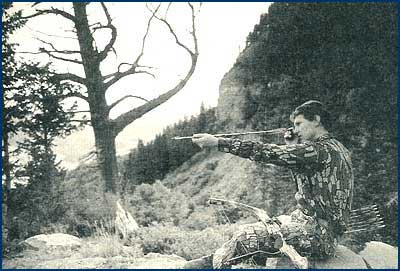
 I
never discount luck. Luck is a huge part of bowhunting and I attribute the
fact that I have the world record Yellowstone elk to pure luck. Now I wouldn’t
say its pure luck when a decent bow hunter finds an animal and gets a shot
at that animal. But to actually lay eyes on an animal that big, I regard
that as pure luck. You don’t deliberately go out and see the 14th biggest
bull ever shot in North America - you just don’t do that. I don't care how
good you are - that’s luck. So I would say I am a lucky guy. But I think,
in the main, any bow hunter makes his or her good luck by just working really
hard and being persistent, never giving up, and doing a lot of research.
I think I have been successful for all of those reasons.
I
never discount luck. Luck is a huge part of bowhunting and I attribute the
fact that I have the world record Yellowstone elk to pure luck. Now I wouldn’t
say its pure luck when a decent bow hunter finds an animal and gets a shot
at that animal. But to actually lay eyes on an animal that big, I regard
that as pure luck. You don’t deliberately go out and see the 14th biggest
bull ever shot in North America - you just don’t do that. I don't care how
good you are - that’s luck. So I would say I am a lucky guy. But I think,
in the main, any bow hunter makes his or her good luck by just working really
hard and being persistent, never giving up, and doing a lot of research.
I think I have been successful for all of those reasons.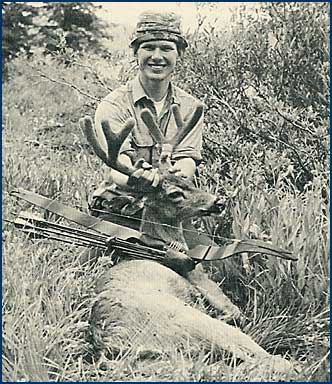
 "knock"
somebody else who may be a really good shot at those ranges.
"knock"
somebody else who may be a really good shot at those ranges. 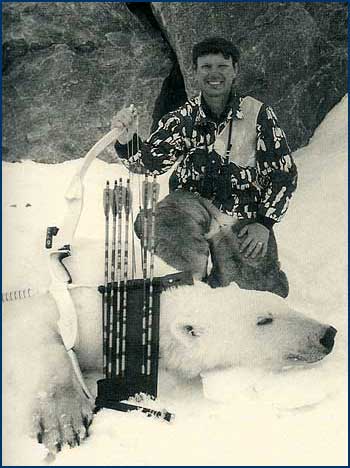 20 yards - with modern compound equipment. I don’t think there is as much
difference as some people say there is between the types of gear. I do know
that if you're a recurve or a longbow shooter (without sights) you have to
keep your shots closer because it’s just a more difficult way to aim. I don’t
think it’s how much weight you can hold but rather it's aiming with sights
or without.
20 yards - with modern compound equipment. I don’t think there is as much
difference as some people say there is between the types of gear. I do know
that if you're a recurve or a longbow shooter (without sights) you have to
keep your shots closer because it’s just a more difficult way to aim. I don’t
think it’s how much weight you can hold but rather it's aiming with sights
or without. 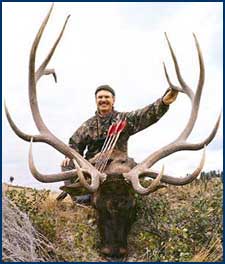 particularly
the Western United States, and there are probably few properties in the world
that could be accessed with an access fee to this day. And if you really
want to hunt and want to put aside some money to get into properties then,
I think, that’s the way to go.
particularly
the Western United States, and there are probably few properties in the world
that could be accessed with an access fee to this day. And if you really
want to hunt and want to put aside some money to get into properties then,
I think, that’s the way to go. 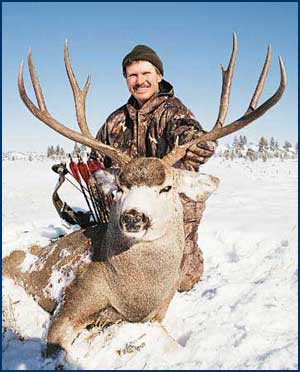 disappeared.
And that’s happening all over the North American continent on a grand scale
- with big game as well. It's an irreversible trend. Thank god the whitetail
deer can live in a hedgerow besides a house or we'd all be in trouble. But
I think that’s the biggest threat to hunting. At some point, as hunter numbers
undoubtedly slide (hopefully it won’t happen very quickly), the anti-hunters
might get a leg up like they have in California with the closing of mountain
lion season forever. The more human population you get the less outdoors
you get. And less hunters are going to have leverage - I think.
disappeared.
And that’s happening all over the North American continent on a grand scale
- with big game as well. It's an irreversible trend. Thank god the whitetail
deer can live in a hedgerow besides a house or we'd all be in trouble. But
I think that’s the biggest threat to hunting. At some point, as hunter numbers
undoubtedly slide (hopefully it won’t happen very quickly), the anti-hunters
might get a leg up like they have in California with the closing of mountain
lion season forever. The more human population you get the less outdoors
you get. And less hunters are going to have leverage - I think.