Bowsite.com
The Nation's Leading Bowhunting Website

With only two weeks remaining until opening day of deer season my nerves were on full alert, in fact my hormones were going ballistic. After months of scouting a particular area, I had come to know the travels of a certain immense buck so intimately that I nicknamed him "the Creature". This buck was what dreams and tales are made of and on opening day he would be mine. Then it happened, disaster struck. I was informed by my supervisor that I had to work at the deer check station on opening day and would not be able to hunt. Needless to say I wasn't having a good hair day. Little did I know, however, opening day would be a day to remember. Opening day began like any other day. I got out of bed, showered, shaved, kissed my lovely wife and went to work. While driving to the deer check station I thought about hunting and my missed opportunity at the Creature. Since it was still dark and the hunters would not be coming out of the woods to check in their deer for the next few hours I decided to drive by the area I had planned to hunt. Upon arriving I was pleased to see only one parked truck. May be, just may be "my" buck would make it through opening day. Suddenly, out of nowhere a large animal ran onto the roadway into the path of my truck, then another. A sudden smack filled the early morning air as my truck came to an abrupt stop. It happened so quickly I didn't have time to react. I got out of the truck to investigate and there lying on the side of the road was a buck, not just any buck, it was the Creature. The animal I had come to know and respect was barely alive. Although I was crushed about what had happened I dispatched the 20 inch, eight pointer and said my customarily hunter's prayer for this magnificent animal. I remember feeling saddened by the loss and wished this magnificent animal had met a better fate.
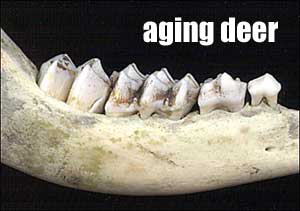
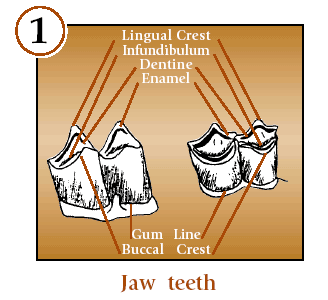
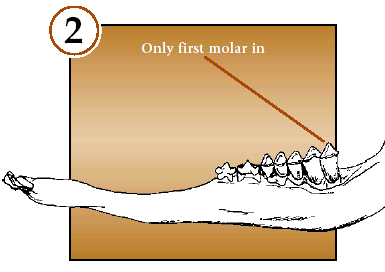
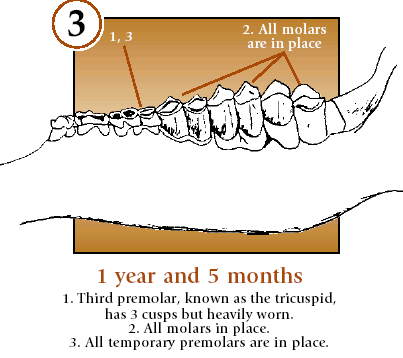
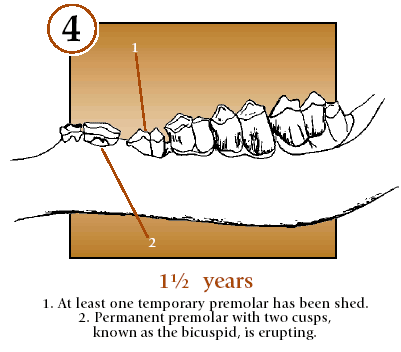
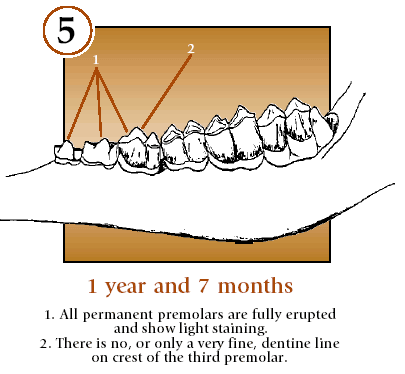
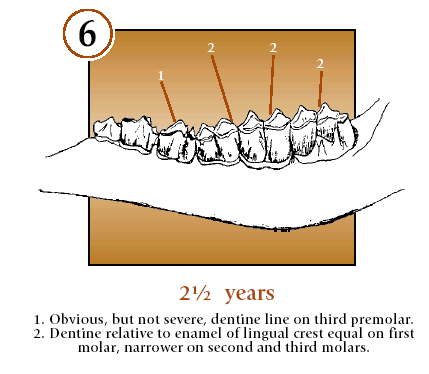
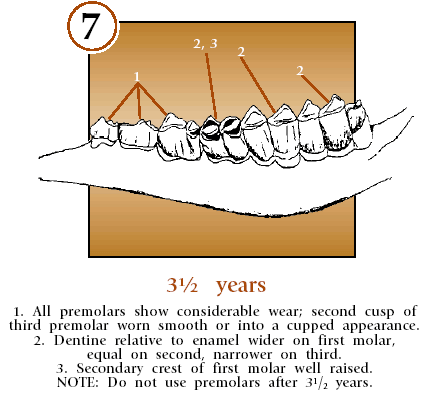
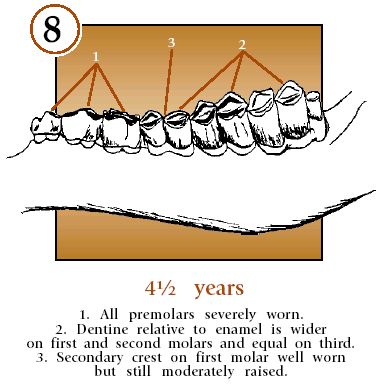
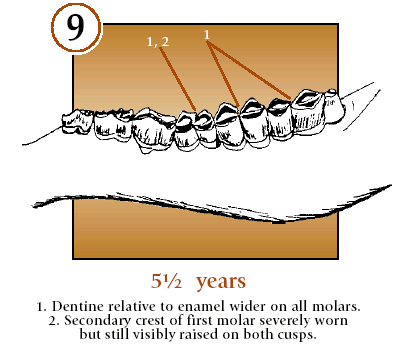
I laid the buck on the bed of my injured pick-up truck and we drove to the check station. At the check station the enormity of the buck drew the attention of several hunters who asked how old the buck was? We recorded all our biological information and pulled his jaw bone. The Creature was 4 1/2 years old with perfectly matching antlers. Someone asked how we knew for sure? I told him it was simple, we lied! Even though some hunters at the check station might have believed this previous statement, biologist use a tooth replacement/wear method developed by deer researcher C. W. Severinghaus in 1949 to determine the age of deer. For example, a fawn born during the spring (May-June) that survived the winter season would be 1 1/2 years old by the fall (November-December) hunting season. At 1 year and 6 months old, deer start loosing their first three bottom, side teeth or pre-molars. During the following month, three new permanent teeth will appear and replace these three baby teeth. The key to aging deer at this age is to look at the third tooth on the bottom. If this tooth has three cusps its a baby tooth and its age is 1 year and 6 months old. If the third tooth has two cusps its 1 year and 7 months old. For the rest of its life the third tooth will have two cusps. How do you age deer older than 1 1/2 years old if all the permanent teeth are fully erupted by 1 year and 7 months? Biologists look at the wear on the teeth. In other words, how much wear is present on the dentine (dark), enamel (white), infundibulum (center of tooth), or lingual crests.
Although this might seem difficult at first, it's just like anything else, the more experience you have the better you become. If you forget how to age deer, I might suggest you tell your hunting buddies that the deer you harvested was 1 1/2 years old. I say this because in many parts of the country up to 75% of all bucks harvested are only 1 1/2 years old. Besides, your hunting buddies don't know you read this article and your already "smarter" then them any way. Before you go and get cocky aging deer, I must warn you that areas that have sandy soils wear down a deer's teeth faster than one with a silty loam soil. This is definitely true if you hunt along the coastal plain. To assist you in aging deer you might want to create a jaw board chart for all the age classes in your area. If you still feel insecure about aging deer, just ask your local wildlife biologist. It always tickles me how many hunters state how they can age deer by the amount of gray on the face or how heavy the deer may weigh. Another misconception is that you can tell the age of a buck by the size of its antlers. This simply is not true. The only real indicator of age is the calcium deposits located in a deer's mouth, called the teeth. Several years ago a hunter approached me at a check station and told me that his big buck was very old because his deer hardly had any teeth. We aged his deer at 2 1/2 years old. He didn't believe us and became belligerent and showed us where the deer had worn down its teeth to the gum line. We politely informed him that deer do not, nor do they ever have any upper front teeth. Needless to say, in some cases public relations at check stations is a pre-requisite. Although the tooth replacement/wear method is the standard in the field, other techniques have been developed to age deer. One method is called the cementum annuli technigue. This technique involves extracting the bottom front tooth or incisor and emerging it in formic or nitric acid. The acid actually decalcifies the tooth so the examiner can literally cut the tooth in half with a sharp knife. A very thin cross-section is cut out of the tooth and stained with a colored dye. The stained tooth section is mounted on a microscopic slide and the number of annual rings are counted. Just like rings on a tree, a growth ring is added every year of life. Thus, if the tooth has 3 rings, it's 3 1/2 years old. Another method involves the eye lens weight. Throughout the deer's life their eye lens increases in weight. Biologists extract the lens from a harvested deer and weigh the lens. The heavier the eye lens weigh the older the animal, whereas the lighter lens' are younger deer. The cementum annuli and eye lens weight methods are more technical and precise, but are expensive and time consuming. The tooth replacement/wear method serves as a quick and accurate method that anyone can use. Hunters should learn to use this method if they're interested or involved in any kind of quality deer management program. Knowing how to age deer is a key ingredient to determine the age structure of your deer herd. Thus, knowing how to age deer is not only important it's crucial.
|